Sep 25, 2026
Malaysia Advances Carbon Market Implementation Through Public-Private Dialogue
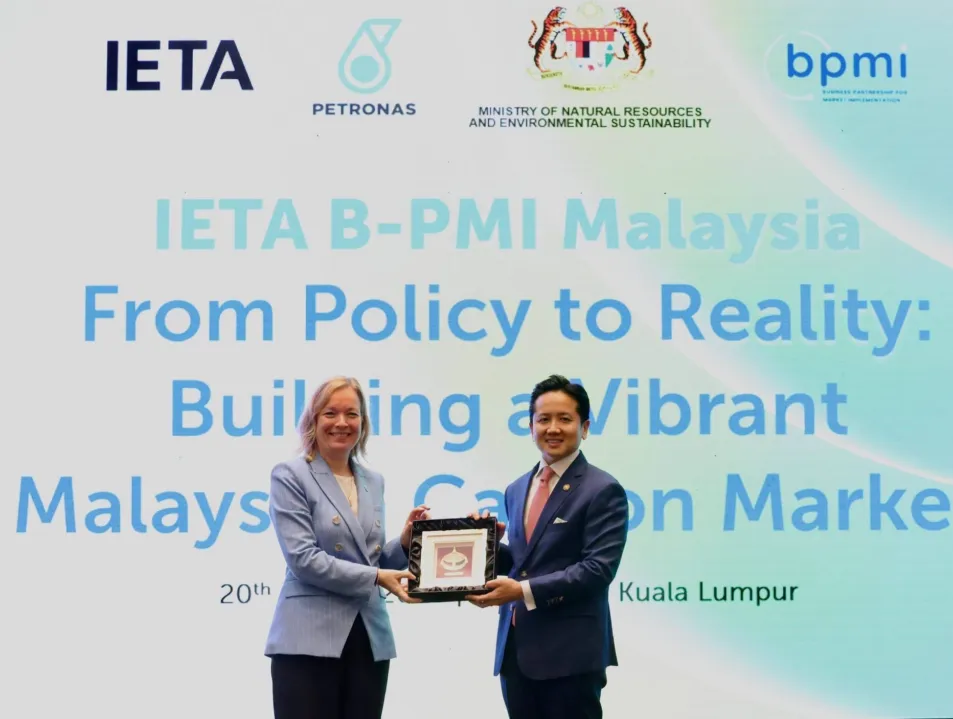
The Business Partnership for Market Implementation (B-PMI) workshop held on 20th August 2026 in Kuala Lumpur convened representatives from the Malaysian Government, ministries and private sector to discuss practical steps towards developing a vibrant carbon credit market.
The keynote was delivered by YB Dato Sri Arthur Joseph Kurup, Malaysia’s Minister for Natural Resources and Environmental Sustainability, and attended by officials representing several ministries and the Civil Aviation Authority of Malaysia and almost 150 private sector representatives.
The B-PMI is a longstanding initiative implemented by the International Emissions Trading Association (IETA) to promote carbon pricing implementation, carbon market expansion, and Article 6 of the Paris Agreement implementation through knowledge transfer and capacity building. It is a forum where experts engage in robust dialogue with industry stakeholders across several jurisdictions.
The B-PMI workshop follows the publication of the Effective Carbon Pricing and Markets in Malaysia: Private Sector Perspectives white paper in 2025. This B-PMI document presented the various models of carbon pricing to be considered in the development of Malaysia’s own system.
Malaysia is currently actively developing its own carbon market design and implementation. The launch of the National Carbon Market Policy in April 2026 marks the important step in providing framework to develop a high-integrity domestic carbon market with international linkages. The next phase will now focus on implementation.
The workshop concluded that compliance requirements are emerging as the most reliable and important sources of demand for carbon credits, and Malaysia has an opportunity to tap into this market by developing its own framework for the registration and issuance of credits.
Carbon markets are expected to contribute to meeting Malaysia's nationally determined contribution (NDC) target under the Paris Agreement; the country has committed to peaking its greenhouse gas emissions between 2029 and 2034 before then reducing them in absolute terms, with an ambition to achieve net-zero emissions by 2050.
Malaysia possesses significant hydrocarbon resources, but also natural assets, especially forests in East Malaysia, which can be the bedrock of a vibrant and robust market in the country.
“This economic climate reinforces the business case for accelerating energy efficiency, adopting low-carbon technologies, and restructuring our production models”, Dato’ Sri Arthur Joseph Kurup, Minister of Natural Resources and Environmental Sustainability (NRES) told the event.
“We value the work of B-PMI in bridging gaps between international and domestic, private and public sector stakeholders; and we look forward to continued collaboration as we embark on Article 6 implementation,” he added.
“Carbon markets are not simply a tool for decarbonisation. They are also an integral part of a broader economic and energy security strategy,” said Nadine Lim Shu Yan, IETA policy advisor.
“At PETRONAS, we recognise that well-functioning carbon markets can accelerate decarbonisation while supporting economic growth and investment.” said Charlotte Wolff-Bye, PETRONAS Vice President and Group Chief Sustainability Officer.
The B-PMI operates in parallel with the World Bank’s Partnership for Market Implementation, aiming to create synergies with the Bank’s programme and leverage overall climate ambition, helping businesses identify opportunities created by voluntary and compliance markets as well as the operationalisation of Article 6.